
If you are relocating from the UK, USA, or Canada to the Costa del Sol, one of the first administrative terms you will encounter is empadronamiento in Spain.
Whilst the word may seem a mouthful, registering on the padrón is a mandatory and foundational step in settling into life abroad.
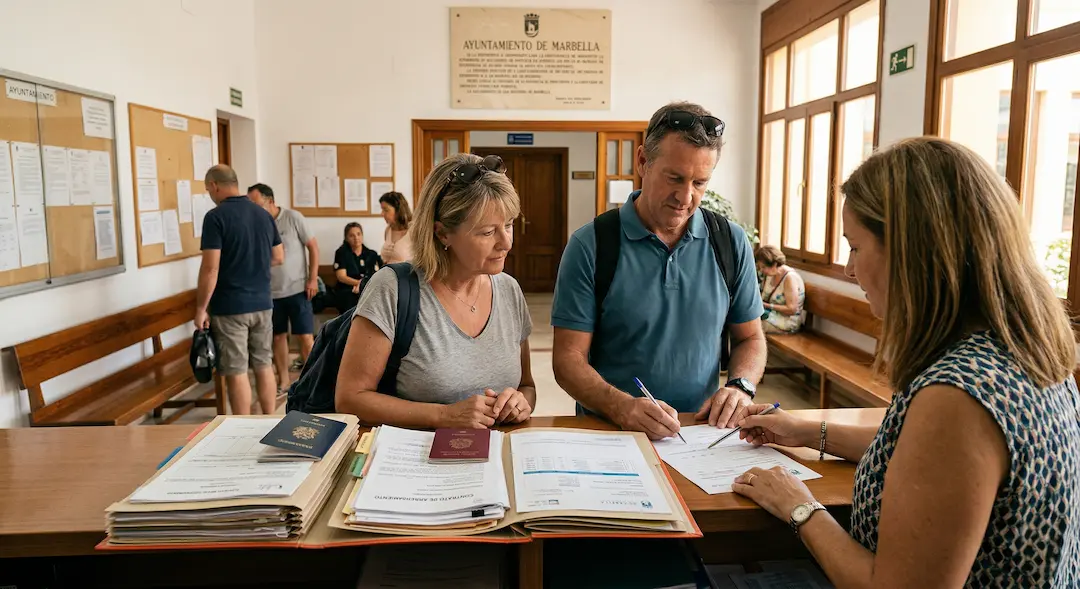
Empadronamiento is the official process of registering your address with your local town hall (Ayuntamiento) so the municipality can maintain an accurate census of who lives within its boundaries.
Local authorities use this data to allocate public funding for healthcare, police, and infrastructure.
In this guide, we will cover:
Empadronamiento is the act of registering your primary residence on the municipal population register, known as the Padrón Municipal.
Every municipality in Spain, whether you are moving to Marbella, Estepona, or Mijas, maintains its own padrón through the local town hall.
When you register, the town hall securely records your full name, nationality, current Spanish address, and the number of people living in your household.
It is important to note that empadronamiento does not grant legal residency or immigration status. It simply serves as official proof of your address.
Registering on the padrón unlocks your ability to live a fully functional life in Spain.
You will be asked to present proof of your registration for nearly every official procedure, including:
By Spanish law, anyone living in Spain for more than six months of the year must register with their local municipality.
This includes Spanish citizens, EU residents, and non-EU residents (including UK, US, and Canadian expats). Both property owners and renters are required to register.
Requirements can vary slightly depending on your specific town hall, but you must generally bring original copies of the following:
What if you are renting a room or staying with someone?
If your name is not on the tenancy agreement or property deed, you will need a written letter of authorisation from the homeowner or primary tenant, alongside a copy of their ID, confirming you live there.
When you register for your empadronamiento in Spain, you will encounter two types of documents:
Important: A Certificado de Empadronamiento is strictly valid for three months from the date of issue. If yours is older than three months, you must request a newly dated copy from the town hall before attending an official appointment.
Registration is completed at your local town hall (Ayuntamiento).
Let’s be honest, Spanish administration has quite the reputation. When our clients first arrive on the Costa del Sol, the sheer volume of forms, stamps, and 'citas previas' (appointments) can feel entirely overwhelming.
Your empadronamiento is often your very first taste of this system.
The secret to surviving it? Over-prepare.
Buy a physical folder, bring every original document you own, and take at least two photocopies of everything. It might feel excessive, but it is the absolute best way to ensure you walk out of the Ayuntamiento with your certificate on the first try.
And remember, if the paperwork ever feels too much, you don't have to do it alone, our team at PCC Legal does this every single day.
Joanne Wilson - Head of PCC Property
Your padrón does not last forever. You are legally required to renew or confirm your status depending on your nationality:
You must also manually update your registration whenever you move to a new address or if there is a change in the household.
“I need to be a legal resident to register.”
This is false. Town halls do not check your immigration status; their job is purely to count who is living in the municipality. If you are applying for residency, the padrón is actually your best proof of exactly when you arrived in Spain.
“Only property owners can register.”
Renters have the exact same right and obligation to register as property owners, provided they have a valid long-term rental contract.
What is empadronamiento in Spain?
Empadronamiento is the mandatory process of registering your residential address with the local town hall’s municipal population register.
Do foreigners need to register on the padrón?
Yes.
Any foreigner living in Spain for more than six months of the year is legally obligated to register with their local municipality.
Is empadronamiento the same as residency?
No.
Empadronamiento simply confirms your current address for local census purposes, whereas residency status is a legal right to live in the country granted through national immigration procedures.
How long does empadronamiento take?
Once you secure an appointment at the town hall, the in-person registration usually takes 10 to 15 minutes, and the certificate is almost always issued to you on the same day.
Securing your empadronamiento in Spain is one of the simplest but most vital administrative steps when setting up your new life.
Getting it sorted promptly ensures your broader relocation journey proceeds without frustrating delays.
If you are planning your move to the Costa del Sol, the PCC group of companies is here to provide an end-to-end service.
Whether you need to find your dream home with PCC Property, secure your residency via PCC Legal, or protect your assets with PCC Wealth, our experts are ready to ensure your transition is seamless.
Check out our detailed area guides along the Costa del Sol and Algarve.
Keep up to date with property news along the Costa del Sol with our blogs.
At PCC Property we don’t just list properties, we unlock lifestyle dreams, Discover how our sales-only, lifestyle-first approach is different.
Who we are
Discover more on our commitment to transparency, trustworthy advice and delivering exceptional client service.